
The BUTTONS Project
Incredible.
6/09/2010
6/07/2010
How BP is controlling Google results via 'The Week'

Just like in the playground when we were kids and you ran to the teacher to get your side of the story across first. BP have maintained this approach and converted it into a public relations strategy and used there billions of dollars to assert their influence on mainstream media. For all the idealism of a democratized media through the means of web 2.0, its a shame that google and other web providers will always sell the top spot of any search query to the highest bidder. Read the full article below.

6/06/2010
A Collective Unconscious Panorama of Personal Experiences
On their own these clips are nothing more than snippets lurking on the public domain with minimal public interest. However once extracted, formatted and placed in a sequence they embody a new cultural significance. My intention is to create a new understanding of the internet by correlating information and finding new meaning through its collective content. In this video, by grouping mobile phone YouTube uploads together it is possible to create a collective unconscious panorama of personal experiences.
I believe the correlating process is more important than the nature of the content however the following video contains two scenes, One from a football match and another from a pop concert.
5/23/2010
THE NATURE OF ENTERTAINMENT DURING AN ECONOMIC RECESSION
This work consists of two record loops. On to the theme of Grandstand and the other to a 1970's caberet version of 'Happy Days are Here Again'. As the country braces itself for continued economic recession television programmers announced that factual programming would be reduced in place of more sports and entertainment programming. These work in progress installations are in response to this concern and just as this cycle of entertainment and sports programming never reach their conclusion, neither do these records.
5/22/2010
ODE TO CAPTAIN MIDNIGHT
Captain Midnight was the alias for a satellite salesman who was at the heart of HBO's biggest TV piracy incident of the 1980's. Captain Midnight otherwise known as John MacDougall was a satellite salesman from Florida who became increasing frustrated with the inflating costs of pay per view television and decided to jam a live broadcast to put his own message across. At 12:32am on Sunday 27th April a 30% of HBO's viewers witnessed there televisions fade into a test screen pattern and the following generated characters appeared.
'GOOD EVENING HBO
FROM CAPTAIN MIDNIGHT
$12.95 A MONTH
NO WAY!
(SHOWTIME/MOVIE CHANNEL BEWARE)'
When asked about the nature of his intrusion he stated '"I didn't know exactly how to start it," he says. "I wrote 'Good evening." I wanted to be polite. I didn't want it to be vulgar or call them names or anything. That's not my style." This intervention was one of the first occasions whereby the viewer had actively changed the relationship with the broadcaster and the viewer and this changed what Marshall Mchluhan considered 'The Life of Forms'.
As the recession began to affect the general public towards the end of 2008 major TV programming agencies within the UK announced that there would be cuts in factual programming and a greater emphasis on entertainment programming. This shift in emphasis was hugely successful in relation to viewing figures and programs such as Strictly Come Dancing and Deal or No Deal, where exported globally and managed to pump 980million back into the UK economy. However, whether cutting peak times slots for cultural programming is positive for our country is my bone of contention.
Born out of a similar frustration with television networks, my ode to Captain Midnight loops a repetitive line from a 1970's cabaret version of the greatly bastardised 'Happy Days are Here Again' (A song written to inspire the American nation during the first national depression of 1928). I intend for this repetition to seep into the subconscious of the viewer and become increasingly irritating the longer they spend with the work. The 1970's cover of the original song originates from a Readers Digest television themes compilation
Whilst simultaneously broadcasting re-edited versions of our new found exports such as Deal Or No Deal whereby the only content I left in the broadcast is applause and cheering. Using a similar character generator to Captain Midnight, these videos are overlayed with the message 'happy days are her again'. These edited videos are broadcast wirelessly on the (soon to be defunct) terrestrial signal and can be picked up by any viewer in close proximity scanning the airwaves.
THE MEDIUM IS THE MESS
A photo-mosaic is usually a collection of small rectangular images that when placed together form a new composition through their collective content. In the early 1990's they were a technological spectacle. However as the decade passed the mosaic effect began to be mass produced on a wide variety of consumer items (these included travel souvenirs, posters and tshirts) now the photo-mosaic embodies a new cultural significance. What was once a statement of technological innovation and a sign of a progressive digital age transformed into disposable items which stand as a testament to outdated technology. Taking this into consideration I have adopted the photo mosaic as a method of satire to exploit current malfunctions in internet ideology
In the 1960's Douglas Engelbart argued that computers were not simply efficiency and productivity tools but could actually be used to 'augment intellect' and by combining human intelligence with a computers capability this could pave the way for a new way of life in a 'integrated domain'. Post 2004 in the age of Web 2.0, one of the major technological innovations has been tagging content. This meta-data makes content more available by browsing or through search queries and all tags are added by the user themselves and therefore there is no editing process. Whilst there is room for human error there will always be mistakes.
The Medium Is The Mess (a reference to Marshall Mcluhans publication 'The Medium is the Massage') acknowledges these mistakes. When searching for Marshall Mcluhan on Google image search, I noticed that many of the images available where not of the man himself although the original tag stated that it was. These incorrect tags undermine the notion of any collective intelligence through the internet and instead of being a progressive medium, they demonstrate that it still has a long way to go.
The materialisation of these concerns exist as a series of photographic prints. I have entered the names of different cultural figures onto google image search and I have downloaded the first 50 results that have appeared. These results are then entered into photo-mosaic software and they collectively reconstitute one random image collected from the search results. Two large prints of misrepresentation of Marshall Mcluhan are placed with my degree show, whilst a collection of ten other cultural figures are presented into book form.
5/21/2010
Independent Newspaper Guilty of Lazy Research
On the 26th of April the Independent newspaper published an article titled 'YBAs : the next generation on show' This article featured the line up for the upcoming British Art Show 7 and had a brief biography of each of the artists involved. One of which was Haroon Mirza who is a studio member in S1 gallery where I am currently participating in my student bursary scheme.
On the day of publication he received an email from the Lisson gallery (who are representing him) telling him that there had been a mix up at the newspaper and the image that the Independent had printed next to his name wasn't actually him. The Independent had quite obviously googled 'Haroon Mirza' and selected the first image they believed to bare his resemblance. Whilst this is an easy mistake to make, as soon as the Independent published this article in the press the issue became more problematic. For all the many mistakes that exist within user generated blogs they hold little online authority, however when a national newspaper publishes an error of this nature, a simple mistake can become a concrete definition of what something is.
The newspaper later apologised and changed the image online, however the printed version is still in circulation and there is another Haroon Mirza out there who was once recognised as the one of new face of British art, he just doesn't know it.
PETER MARTIN

UPDATED IMAGE OF HARROON MIRZA VIA THE INDEPENDENT 27/4/10
5/20/2010
PSL - Image and Memory
'In this unique and ground-breaking collaboration between artist-led contemporary art space PSL and the Yorkshire Film Archive, artist Diane Howse presents film stills and home movie footage exploring the theme of image and memory through life at home in Yorkshire during World War II.'
The first thing that struck me about this exhibition was the sheer amount space in the gallery. The highlight of the show was the small projections room detailed in one of my photos in the slide show. Instead of trying to calibrate the projectors in a perfect line images were scattered all over the walls at various height and sizes. This felt slightly liberating, as if they were photographs scattered across a table top and complimented the idea of flicking through archives. However the installation of the images from the show, whilst technically to a very high standard the nature of the framed enlargements felt quite dry in comparison to the sense of atmosphere that was created within the projection room and was almost as if they were placed around the gallery to fill the vast amounts of space.
The first thing that struck me about this exhibition was the sheer amount space in the gallery. The highlight of the show was the small projections room detailed in one of my photos in the slide show. Instead of trying to calibrate the projectors in a perfect line images were scattered all over the walls at various height and sizes. This felt slightly liberating, as if they were photographs scattered across a table top and complimented the idea of flicking through archives. However the installation of the images from the show, whilst technically to a very high standard the nature of the framed enlargements felt quite dry in comparison to the sense of atmosphere that was created within the projection room and was almost as if they were placed around the gallery to fill the vast amounts of space.
My other problem with the show, which is slightly petty, was the half staging of the reading room. It just felt a little half arsed. The chair and table were nicely selected yet the television on top of the table was a tacky monitor that wasn't in keeping with its surrounding. It would have been better to use a modulator through a DVD player so that an older television set could have been used. If this room fell short because of budget reasons, then it should have been kept much simpler. When it comes to staging I believe it has to be all or nothing.
The strange part of the gallery was the entrance. The two invigilators for the show sit on a desk directly across from the entrance and the guest book sits on a table in front of them so it is extremely awkward to write your opinions, which isn't really helpful for anyone.
Taken from HERE
Ellie Harrison
This was one of the most important digital artworks that I managed to see this year. Whilst there is a lot of representational net art that represents the potential of new modes of communication this work is live and it works on the basis of expectation. We know that bad news is coming and therefore we know that this work will function. It is not based on our understanding of technology as a medium, it is based on a perception as living organism with predictable characteristics.
Whilst the BBC are a public service, so are vending machines and the relationship between the these two forms is crucial. They are both classless.
The folling has been taken from HERE
Original Statement
'A rundown but functional old vending machine stood alone in the Dukes Bar. Every now and again, without warning, it would spring into life - spewing out free packets of crisps for gallery visitors. The machine had been modified. It no longer functioned in the conventional way - at the whim of snack-hungry theater goers - but instead found itself in the control of outside forces...
Its new nervous system was a networked computer. Hidden out of view and running special software, it continually scanned the BBC News RSS feed - commanding the machine only to release snacks when words relating to the recession make the headlines.
Whilst seemingly an act of generosity - gifting free food at moments when further doom and gloom is reported - the Vending Machine also hinted towards a time in the future when our access to food may literally be determined by wider political or environmental events. We may not be able to access what we want, when we want, at the touch of a button'
5/17/2010
Cinema Povera - 16mm Film Workshop


Cinema Povera is an independent artist group based in Leeds. Last weekend I visited their 16mm found footage workshop after I picked up a leaflet in PSL. Their workshop was part of Leeds councils Art in Unusual places program which encourages artists to occupy vacant spaces around the city centre. When I arrived it was pretty uncomfortable, it seemed like it was a close nit group of people, however I asked to speak to the organiser about the project and she introduced me to the process of splicing film and making 16mm loops. I asked about the nature of the project, and what there relationship was with dead mediums and why they ran these workshops, she replied she liked the feel and its aesthetic and sound, and the conversation didnt expand into any philosophies of film, but thats not a bad thing. The fact that they were devoting there time to teach people the skill set required to edit with this medium said enough about there intent on preserving its longevity.
The following is a short film showing all of the 16mm film loops that were taken that day. My loop is the first one to be shown.
5/16/2010
CORRELATING CONTENT & SUBVERTING SENTIMENT
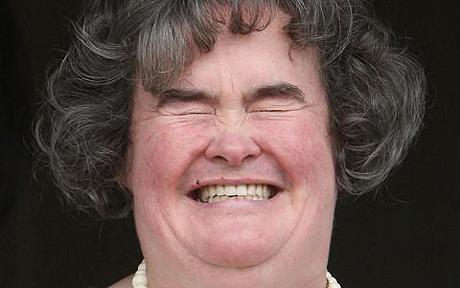
At the time of writing a YouTube clip of Susan Boyle (a contestant on a national television talent contest) has received over 92 million views. Over half a million comments have been left on the page. With each comment averaging out at around 15 words, YouTube users have unconsciously collectively generated enough collective content to write over 100 novels worth of information making it one of the top five 'most discussed' videos on YouTube.
Originally I planned to print the entire comments history of Susan Boyle, however this did not exactly go to plan. Whilst I was working YouTube 'updated' its website, claiming it was making the website more minimal and user friendly, however this was a mask for their true intentions. When trying to view all comment on a particular item the page would always get stuck when you passed a months worth of information. Whilst this appears to be a minor technical fault, it is consistant and runs through every video on the site. Displaying thousands of comments uses excessive bandwidth and when YouTube updated there site they reduced the amount of comments that a user could view, yet made this appear as if your internet browser had malfunctioned.
Confronted with this I began thinking about all the content collectively being written that was disappearing into a digital abyss. At this point I chose to look at two other videos taken from the top five 'most discussed' section. They were 'Charlie Bit Me' and 'The Real BNP Supporters'. I believe the nature of the three videos covers three areas of public interest. The banal, the spectacle and the political and I then decided to print out all of the comments from each of these videos for the past month turning them from digital data into a tangible physical form, so I gathered as much information as YouTube would let me and began printing.
My main drive for printing a months worth of comments for each of these videos was to express the absurdity of trying to document digital data and to also preserve a social history that would have been lost. . A mere months worth could fill a filing cabinet. So I bought one. I then decided that if my intentions and motivations for doing this project were to hold any sort of conviction I would have to continue this process for the duration of the degree show, so I bought two more filing cabinets.
It is worth adding that in my original proposal for the exhibition I wanted to place cut away walls with bound copies of every Susan Boyle comment ever written. However I started to believe that this method of display compromised the work and as soon as the comments became bound it transformed the comments from being about the process of archiving (within the cabinets) to the end product of the book and I believe that the process of archiving (whether a feable attempt or not) was crucial to the aesthetic and value of the work.
5/15/2010
Technical explanation of how Google image search works
Taken from here
''Google uses an algorithm to determine their search results, it's mission is to index everything and have it available on Google. Now that includes porn, gross pictures of people with their heads blown off and yes even fluffy bunny's.
Part of this computerized machine calculates what should be shown first, second, third, and so on. It's determined by popularity of links, how many times someone clicks on it, and over a hundred other factors.
Also in reply to "what will other countries think of us when they see this". People in different countries see different results. The world isn't revolving around us here in the US and every search engine takes that into consideration when showing search results.
Now, Google built up the huge name you know today by showing relevant results to it's users search queries. Their system works amazingly well. So the truth is a lot of people may not like this image but they sure are looking at it and linking to it so that makes it more "popular" in the search engines eyes.
Google can't just go and remove everything that people find offensive if they did they would lose their integrity to be impartial. So if you don't want the image to come up anymore people need to stop linking to it clicking on it and discussing it all over the WWW because in Googles machines eyes this is a very popular picture of the first lady.
And apparently it is, even though it's for the wrong reasons. But who is to say what's right and wrong or funny or sad.
Not Google that's for sure.''
ARTIST LINKS - FULL PROJECT REPORT
Artist Links Process

When a date has been decided to run an Artist Links event a Facebook events page would be set up and digital invitations would be sent out to everybody on the fine art course. The event was set up in such a way whereby anybody could become a moderator and therefore invite all of there friends to join in with the event. This required an element of trust from users as a new admin member had control to delete the event completely, however the risk paid off because people were generally happy to help.
Once the event and guest list had been established, Facebook also gives you the option to send a message out to all of your guests at the same time. My message to all potential guests requested that anybody wanting to be involved with Artist Links simply had to send me a link to there favourite YouTube video, the only requirement was that it was under 5 minutes in length or that if it wasn't I would more than likely be editing it down.
It is at this point that the process becomes more involved. I would receive on average about 20 emails with multiple links. If somebody sent me a message with three clips in it, I would usually just work my way down the list until they had used their allocated time period. This was because for the success of Artist Links as a snapshot of studio culture it became essential that my artists hand does not bring the validity of the film into question.
Once the clip had been loaded up on youTube and I have checked that it worked I then copied the URL of the clip into a piece of software called 'YouTube Downloader HD' which then pasted the clip onto my desktop. Once all of the clips have been downloaded I pasted them into a corresponding folder, for example 'Artist Links 9/12/09' and opened up my second piece of software that was needed 'FLV Converter Pro'. Once all of the files have been converted from FLV to AVI they are ready to be edited.
All files are highlighted and then dragged into Windows Movie Maker. In movie maker, You then make a brief title sequence with the date of the event and place the clips into the time-line in no particular order. Placing the names of the person who submitted before every clip.
Artist Links 1

Artist Links 1.0 was on a very cold night in December 2009. I had paid local graphic designer Sarah Abbott to design the flyer and I had heard that there were a fair amount of people coming down to see the event. As I was unsure about the number of visitors to the event I held it in the small gallery space in Arundel Gate court. The building already has pc stations with inbuilt projectors. I decided this evening to keep the edited file on my removable hard drive as this meant that the edited file would not be compressed. There were a lot more people at the event than I had anticiapted for. However the smaller environment made a closer atmosphere, like a gig in a small venue.
As the clips began to be streamed I noticed that people felt embarrased about having there name placed before there chosen clip. Most of the submissions came quite flippantly through Facebook with very little consideration, however once they were in a room full of there course friends people felt a pressure for there clip to be entertaining and this highlighted my first point of concern for the success of Artist Links. Are people choosing clips or are they trying to impress there friends? However this awkward tension before a participants clip was shown is in no way detrimental to the end product of the evening, the DVD of collective content. This is because in making this digital archives of the passions and tastes of our course it is unescapable that people will not adhere to the collective in which they belong.
As the evening drew to a close it became apparent to me that slight intervention via my hand was necessary in making future events a success. I simply needed to pace the clips better, placing long clips next to brief ones, would go further in keeping the audience engaged.
When the film ended I made a brief speech and reiterated my thanks for all the submissions I had received and suggested that the dialogue continued in the pub.
Artist Links 2

After the success of the first event in the series I decided to continue the experiment to see what happened by repeating the process of the first event. As usual I made a call for submissions and they began coming in quickly. Around this time I had won a place on a student bursary program in S1 gallery and therefore I asked for help form the head curator, Louise. She kindly forwarded my call for submissions to all of the members within the Gallery
Although I wanted to get another flyer made with Sarah Abbott time constraints on her part meant that it would not have been possible to make one in time, so with the help of fellow student bursary member Linny Venables we made a flyer in the studio at S1 gallery. We also decided to make the flyer into a stop motion animation whereby this could be uploaded to YouTube to promote the event further.
I wrote a new statement of objectives for this event and posted another call on Facebook and waited. This time I only got a total of 20 clips, so I had to enter into murky territory for a curator 'Pestering people for submissions' I did this via the chat client on Facebook. Having access to over 300 people, I could usually find somebody I wanted to be involved and suprisingly this new tactic of pestering people via web 2.0 platforms was effective and commonly people did not understand the nature of the project so this only opened up the dialogues further.
With numbers higher than expected at the first event I thought it would be a good idea to find a bigger space to screen the submissions. So I moved next door. Other new additions included having a bar for refreshments and having a second projector in the communal area showing music videos whilst people waited at the beginning and in the intermission
This event was by far the most successful in terms of attendance and there were at least 40 people present for the screening. As I highlighted earlier I was concerned that after the first event the nature of the submissions may change because people may have noted audience appreciation and disapproval. I was right, they had although this was in no way detrimental to the night, people had actually strived to surpass there original submissions from the first event and the event began to feel more like a a community making these collective screenings together and therefore my role as co-ordinator was successful as the event was not focussed around me.
Artist Links 3

The final Artist Links of the year was the least successful. Against the advice of my friends I booked it on a night before university deadlines were due and this had a knock on effect on the numbers of people at the event. Whilst numbers fell from 40 to 15 people there were still positives to be taken from the event. The normal method of placing peoples names before the start of a clip had been scrapped. This made the editing process much simpler and relieved peoples personal tension for the clip they were about to show. I also started to group the content together in terms of its theme, if one appeared during the editing process. The major new theme that emerged from this session was 'autotune remix' were basically the banal was re-edited into a song through the use of auto-tune software, which was becoming a popular YouTube trend at the time.

5/12/2010
RESEARCH - Max Headroom Pirate TV Incident
Analogue anarchism!
On a late-November evening in 1987, two Chicago television stations were victims of a broadcast signal takeover.
After an earlier hijack attempt on WGN-9 during the 9:00 News , a broadcast on WTTW-11 of the Doctor Who episode "Horror of Fang Rock" would be interrupted by a man wearing a Max Headroom mask. The crazed person uttered mostly gibberish and bashed the Chicago Tribune and its subsidiaries, before he dropped his pants and was spanked by what appears to be a child. 90-seconds later, the program returned to normal. To this day, he remains at large.
5/07/2010
Michelle Obama racist image sparks Google apology
This is another example of how online representation can be affected by badly tagged information.
'Google has apologised over a racially offensive picture of Michelle Obama that appeared when users searched for images of the US first lady. The image came top of the Google Images serach results for "Michelle Obama".'
Original BBC Article
5/06/2010
My War at FACT Liverpool
'In a period of global unrest, FACT presents MyWar, a radically personal look at conflict through the work of 12 international artists. Their artwork investigates the reality of conflict at a time when digital networking has changed the way we receive and respond to information.'
This was by far the worst exhibition I have ever seen in fact. I went with a friend to the gallery and I have always been a large advocate of the space but I was embarrassed of what I took them to see. I have heard rumours from people in Liverpool that they have had large cuts in arts funding, I don't know whether this is true or not, but it does not excuse the poor finish within the exhibition. The floor reminded me of the old TK Maxx that has recently been closed down. It looked a mess. On the second floor they had some nice prints on from memory what I remember to be tiles, however the nails keeping these tiles in place were bent and crooked. There were many other floors but I think these were bad enough to get the picture.
My other qualm was the work. Im getting bored of Thompson and Craighead. Two LCD monitors placed side by side with a bench and headphones is just boring. It didn't convey what I believe to be fundamental to the work - the nature of global information and user generated content collectively forming new narratives. This mode of display sparks little interest from the viewer and lacks imagination. A better example of a global snapshot of communication would be a work like 'listening post' by Ben Rubin and Mark Hansen as this mode of display triggers a more emotional response to the nature of technology. Thompson and Craigheads installation is a much weaker piece than their previously installed 'Beacon' in presentation and content.
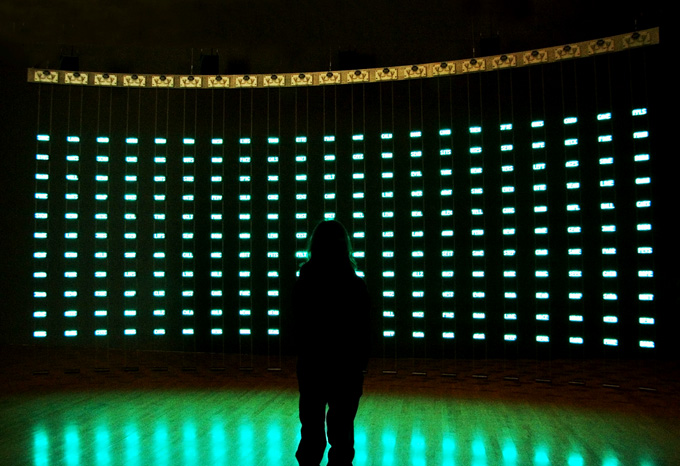
This was by far the worst exhibition I have ever seen in fact. I went with a friend to the gallery and I have always been a large advocate of the space but I was embarrassed of what I took them to see. I have heard rumours from people in Liverpool that they have had large cuts in arts funding, I don't know whether this is true or not, but it does not excuse the poor finish within the exhibition. The floor reminded me of the old TK Maxx that has recently been closed down. It looked a mess. On the second floor they had some nice prints on from memory what I remember to be tiles, however the nails keeping these tiles in place were bent and crooked. There were many other floors but I think these were bad enough to get the picture.
My other qualm was the work. Im getting bored of Thompson and Craighead. Two LCD monitors placed side by side with a bench and headphones is just boring. It didn't convey what I believe to be fundamental to the work - the nature of global information and user generated content collectively forming new narratives. This mode of display sparks little interest from the viewer and lacks imagination. A better example of a global snapshot of communication would be a work like 'listening post' by Ben Rubin and Mark Hansen as this mode of display triggers a more emotional response to the nature of technology. Thompson and Craigheads installation is a much weaker piece than their previously installed 'Beacon' in presentation and content.
LISTENING POST 2009
My other complaint was the selection of putting Phil Collins 'they shoot horses' into the exhibtion. This work has been around so many galleries in England I think people are getting bored of looking at it. Surely there are other artists working around the themes of sociual networking that would have been a wiser or even braver selection for the curator. This isn't to say I dont like the work, I just dont want to see it again for a while.
5/04/2010
ARTIST RESEARCH - CORY ARCHANGEL
I have only recently become aware of the work of Cory Archangel but this is one of the most exiting pieces of digital net art I have seen in a long time. The most interesting point about his practice is that he goes to great lengths to explain the entire technical process he has gone through to achieve his final out put. For example for this piece he has written on his website ;
'' So, I probably made this video the most backwards and bone headed way possible, but I am a hacker in the traditional definition of someone who glues together ugly code and not a programmer. For this project I used some programs to help me save time in finding the right cats. Anyway, first I downloaded every video of a cat playing piano I could find on Youtube. I ended up with about 170 videos. Then I extracted the audio from each, pasted these files end to end, and then pasted this huge file onto the end of an audio file of Glenn Gould playing op11. I loaded this file into Comparisonics. Comparisonics, a strange free program I found while surfing one night, allows users to highlight a section of audio, and responds by finding "similar" sounding areas in rest of the audio file. Using Comparisioncs I went through every "note" (sometimes I also did clusters of notes) in the Gould, then selected my favorite "similar" section Comparisonics suggested and wrote it in the score. After going though the 1000's of "notes", the completed scores were turned into a video by some perl scripts I wrote which are available here if you wanna do something similar. ''
Not only is this a comprehensive guide to recreating the work yourself, he is even giving you access to the code that he has written to make the process work. By making this information available to the viewer, anybody could extract elements of this work and bring them into their own practice. This approach makes for a much progressive piece of net art for if all net artist shared aspects of their practice to each other, well at least the technical aspects then this would undoubtedly only lead to better artworks being created.
Below are three examples of clips of cats playing piano from YouTube reconstituted to play Arnold Schoenberg's 1909 op. 11 Drei Klavierstücke (aka Three Piano Pieces)
The original link is located HERE
4/25/2010
Laura J Martin - The Hangman Tree
When I knew there was a possibility of making a music video for a song due to be released I considered how I could make a video in relation to my practice. My solution was to use archive film, that had already been used on other projects across the internet.
The footage I choose to use was called 'Bartow Family Camping Trip' which is 16mm footage of an infamous American family who camped across every state in America. Due to the sentimental nature of the song the footage and the video work well together and my video is now added to a small selection of other artists who have bastardised this footage.
3/26/2010
TODAY'S STUDIO SET UP

CASSETTE BOX / SELENA RADIO / TITLE GENERATOR / AUDIO MIXER
ALBA B&W CAMPING TELEVISION / PHILLIPS COLOUR TV
2/26/2010
TERRESTRIAL SIGNAL ON CATHODE-RAY TUBE DISPLAY
By 2011 all terrestrial signal will be turned off throughout the UK. A medium which has been stable and used by millions of households since the 1920's will no longer be available. But what will we miss about it if anything? I have attempted to capture the romanticism of the terrestrial signal through a series of macro images, as once the medium is switched off there is no way to get it back and this project is to archive the nostalgic and sentimental qualities of the transmission.
2/07/2010
Playing DVDs through Old Televisions

This is actually quite a simple procedure and doesnt take too much tinkering. Here is how I achieved the following set up ;
1 - Firstly you need a Universal Modulator. These are available from Maplin for about £30 however you can buy cheaper ones on ebay for around £10
2 - Connect your DVD player via the scart socket or RGB cables.
3 - Connect the RF Output to the TV (For this set up I also required an RF big-to-small adapter)
4 - Tune Your TV to channel 21
Note - The Maplin universal modulator converts stereo sound inputs to mono.
1/26/2010
iGoogle Photography Prize
My proposed selections for a theme are re appropriated family images. These carefully selected and cropped images embody strong cultural codes and disclose feelings and identities that are easily related for Google users. Focusing on the hands these images are expressing understated yet beautiful gestures within the context of family.
9/03/2009
MSG = MED
Working alongside Liverpool based artist John Oshea on his intervention at a digital media conference at FACT center in Liverpool I played the role of a shopkeeper turning peoples mobile phone text messages into key rings at a digital media conference whereby all the attention was tuned into progressive technologies. However this intervention switched the focus for the conference attendees into the sentimental nature of the object, opposed to its function. We successfully subverted the emotions of our 'customers' and restored an attachment to 'outdated' in a day about the 'future'.
5/13/2009
Quadruplex.
This was a group show at S1 Gallery. The Group statement is visible on the second image. The accompaniment to my work is copy and pasted below.
An Instinctive Unconscious Panorama of Personal Experiences
I am interested in the digital phenomena and how our culture of image recording has changed through the evolution of photographic mediums. With any cultural shift it is important for it to be acknowledged and considered wherever possible. Recording is now something that we all take for granted. Are we entering into a culture of digital verification? Whereby our videos or photographs are self indulgent testimonies stating ‘I was there!’ uploaded onto any user-generated network. Or is it possible to find meaning in collective content?
Will we leave behind a rich database of visuals that portray the human experience? Or will digital information get lost within in itself whereby it is so over saturated it become impossible to find anything of substance or of tangible physical quality like previous analogue mediums such as the film negative.
This video exploits the contemporary digital culture of obsessive over documentation of our lives. The appropriated video footage within the piece consists of video clips recorded on mobile phones and digital cameras at a football match. At a crucial moment within the game a penalty kick was awarded to one team. This allowed their supporters to instinctively ready their phone or camera recorders in preparation for a decisive moment in time. Unconsciously everybody who filmed at that moment made it possible to make a instinctive unconscious panorama of personal experience.
DVD on Monitor : 6 minutes
Stop-gaps of Imagery within a Digital Culture
The current I-generation treats the medium of photography in a different way to those before: through a Post Modern methodology. We are now over exposed to the medium of the Image. I am concerned with the notion that contemporary image-making is something that has become disposable; whereby the digital images that are created are rarely made into tangible, physical objects. After a cultural shift from the film generation to a digital age it is important for us to reassess our position on image-making and our motivations.
In this work I interview my former manager by whom I was employed as a camera salesman for a high street retailer. As we both have personal art practices relating to image-making, we open a discourse into how our time at the shop changed our approach to photography.
I am also looking at the phenomena of the disposable camera and making the parallel between the cavalier approaches to image-making, how it may be similar to digital photography and how both mediums changed the accessibility of photography.
Presenting the work on a purpose built projection screen, I house the original cameras used within the piece. There is also an investigation into the correspondence between the conceptual assessment of image-making and the literal theoretical assessment of the image that is presented to the viewer.
Video Projection : Interview with John Oshea 52 minutes
DVD Monitor 1 : Vectoscope
DVD Monitor 2 : YC Waveform
DVD Monitor 3 : Collection of Failed Negatives
Subscribe to:
Comments (Atom)